The State of the Expert Economy 2026
They said AI would commoditize expertise. Instead, it repriced it.
When I started writing about the “Expert Economy” almost two years ago, the term didn’t exist. I’d describe it at dinner and watch people file it next to “gig economy.” It sounded adjacent, vaguely millennial, and probably involving a ring light.
That conversation is over. If AI is becoming the operating system of work, the Expert Economy is the clearest early signal of where work is heading. It’s arrived the way structural change usually does, one small change at a time, like the snowball rolling down a hill, until it’s impossible to miss.
A financial planner starts a newsletter. A laid-off product manager turns her playbook into a cohort-based course. A McKinsey partner who spent years building a LinkedIn following on the side quits to advise the four clients it brings him, making more in his first year than the partnership paid.
My favorite example is James Conole, founder of Root Financial. On the surface, he is one of approximately 326,000 personal financial advisors in the United States offering similar, commoditized expert services, the same as an estate attorney, orthodontist, pediatrician, or electrician. All have valuable technical skills, none of which is especially differentiated other than the personality (or, I prefer “character”) offering the service and their brand behind it.
James did one thing that interrupts the commoditized nature of every professional service: he started teaching, for free, on YouTube and hosting a podcast called Ready for Retirement. The audience grew from ~14,400 subscribers in 2022 to more than 215,000 today, with over 10 million views and listens a year.
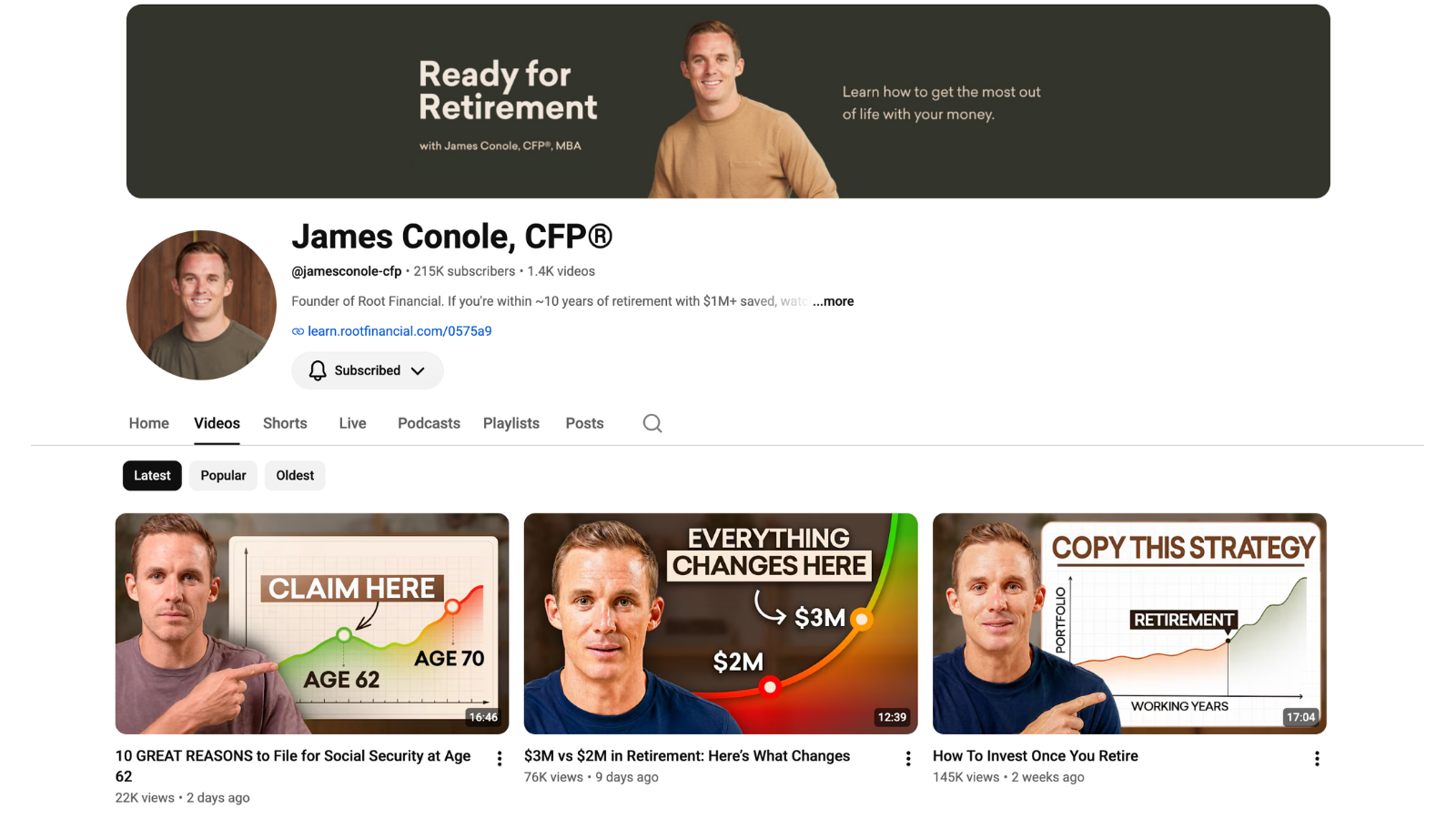
This audience became the business. As viewers and listeners interested in financial planning grew to trust James’ advice on social platforms, they came to James for his paid service. Now, Root Financial manages $2.4 billion in assets, built from zero in about six years with no outside capital. About 75% of his clients are high-net-worth households.
James has the same credentials as those 326,000 peers, but he built a radically different outcome by turning his expertise into media, and his media into the firm's pipeline.
None of these experts call themselves "creators," nor are they part of the "Creator Economy" that's gotten all the attention this past decade. But all of them are creating content to share and sell their expertise, on their own terms, to a market that increasingly prefers buying it that way.
This is the state of the Expert Economy in 2026.
The Six Trends Shaping the Expert Economy in 2026
1. The market: Experts are one of the largest categories of work
Depending on the definition, 64 million (Upwork) to 73 million Americans now work independently, roughly 40% of the workforce. The number has nearly doubled since 2020, when MBO counted 38 million, and the full-time core has doubled outright. According to MBO Partners, 28 million are full-time, about 17% of the U.S. workforce, and the rest are part-time side hustlers who earn independently at least once a month.
This means nearly half the U.S. workforce will earn independently by 2027. I called this threshold nearly two years ago while building Sell It. 2027 then felt so far away, and now here it is.
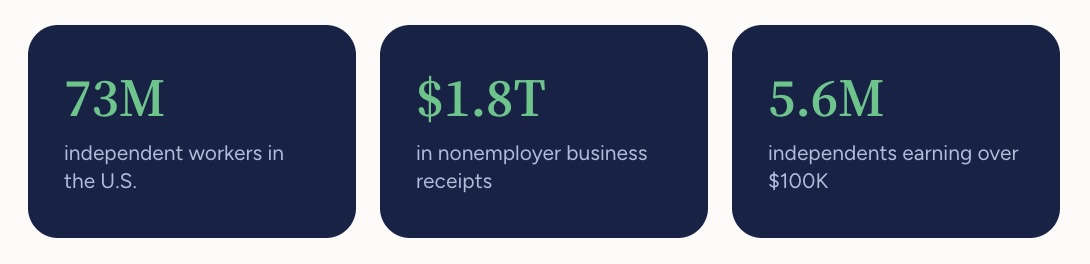
Behind the headcount is real money. The Census Bureau counts 30 million nonemployer businesses generating $1.8 trillion in receipts, about the size of Australia's entire economy and larger than all U.S. e-commerce. It's a segment growing 2.7% a year since 2012, more than double the 1.1% pace of employer firms. A record 5.6 million independents now earn over $100,000, up nearly 19% in a single year.
The "team of one," now armed with software that’s replaced payroll, stopped being a hypothetical and became a viable business model. This applies to full-timers and side-hustlers.
None of this reverses when hiring picks back up. The pull of independence has a matching push: confidence in the traditional career ladder is eroding. Fortune and Forbes have both tracked the rise of "career minimalism," where workers keep a W2 for stability but move their ambition into portfolio work and side hustles. This is a structural migration of talent, income, and ambition out of the org chart and into businesses people own. The expert layer, where people sell judgment instead of hours, is the fastest-growing part of it.
2. The Expert Economy is not the Creator Economy
A lot of this gets misappropriated to the "Creator Economy.”
The Creator Economy is real, but it's an attention business. Roughly 70% of its revenue comes from brand deals and advertising, which means most of it is entertainers and media personalities monetizing eyeballs. MrBeast is the archetype, and there's no structural difference between what he does and what Jerry Seinfeld did with a sitcom in the 1990s.
It's a legitimate business. It just isn't this one.
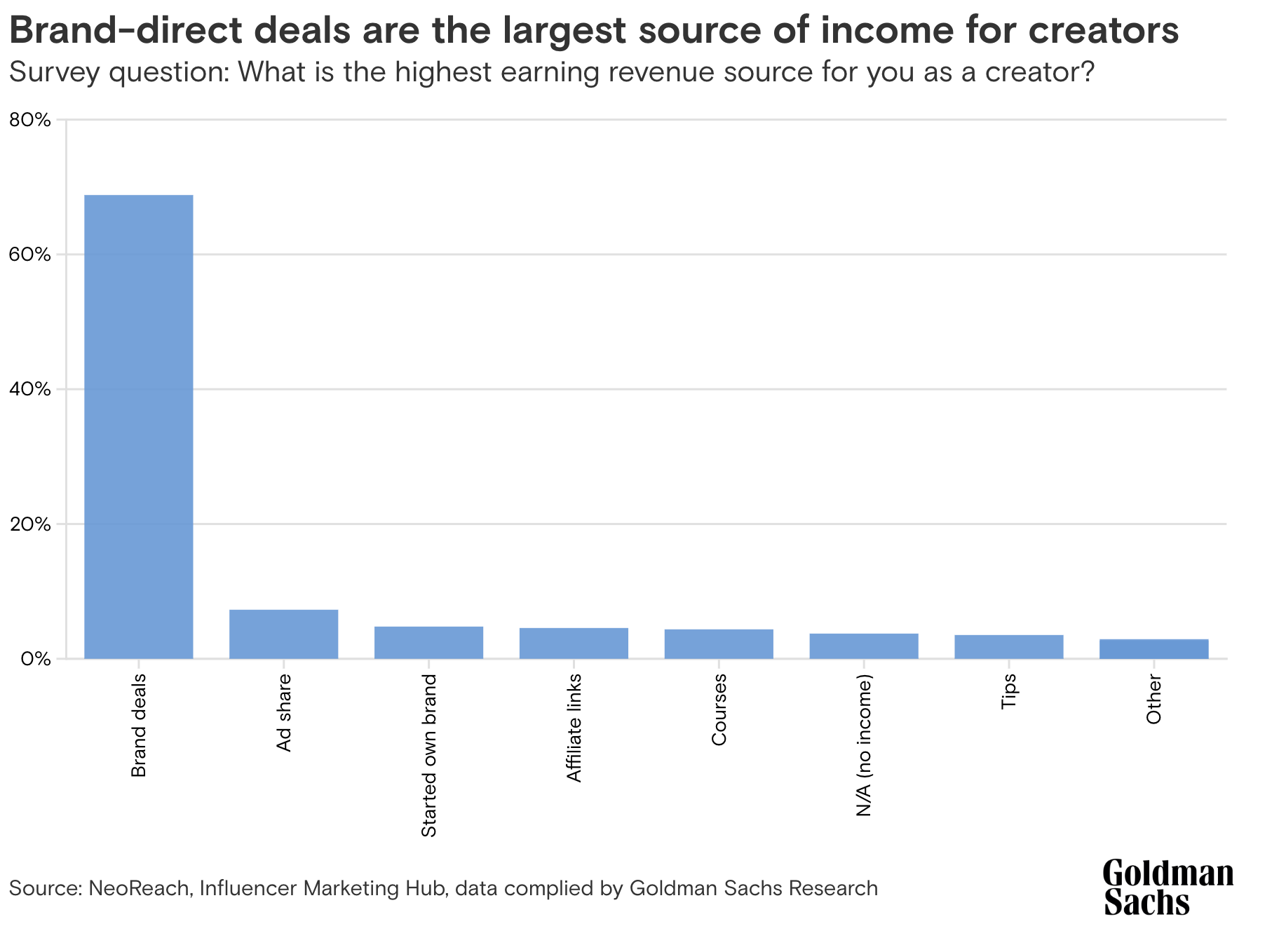
Here’s an easy way to think about the difference: Experts’ customers are their audience, and creators’ customers are advertisers.
For the past few years, “the Creator Economy is taking the world by storm” has been a big trope, fed by the Goldman Sachs report that it is roughly a $250 billion industry. Hidden in all of this are the silent experts using creator-like strategies to sell their expertise within a $1.8 trillion market, about seven times larger than the Creator Economy.
You see it even near the top of Forbes' 2026 creator list: Mark Rober (No. 9) is a former NASA engineer. Steven Bartlett (No. 3) builds and backs real companies. Codie Sanchez (No. 10) spent fifteen years on Wall Street before she started buying laundromats and car washes. Erika Kullberg (No. 41) is a practicing attorney who out-earns creators with ten times her following.
The label on the Forbes list says creators. These résumés say expert. They didn’t build an audience and then look for something to sell. The audience formed around work they were already doing.
Codie took it furthest. She built a holding company that buys the exact businesses she writes about every week: laundromats, car washes, vending machines. Her audience and her operating company are the same thesis.
Strip away every platform tomorrow and she, along with every other expert, would still own a real business.
3. AI repriced expertise
The fear of 2023 and 2024 was straightforward: If a model can write the memo, build the model, and draft the contract, what is the expert for?
The headlines made it seem settled. As recently as last year, Anthropic's CEO warned that AI could erase half of all entry-level white-collar jobs in Fortune, and CNBC was already calling it the end of the career ladder.
Today, we see how this has played out. As AI absorbs the technical work — production of knowledge, and answers to questions only experts once knew how to find (think: legal case law) — differentiation moves from technical firepower to human judgment, insight, taste, and the ability to build relationships around trust.
You always hired a person. What changed is why. The expertise used to be the scarce thing, and the person was just how you got to it. Now that the expertise is free, you're paying for something else: whether you trust their judgment, whether you like how they think, and whether you believe them when they tell you the thing you don't want to hear.
Call it the human "it" factor.
Through Prolific Authority, my venture studio, I work with Myka Meier, founder of Beaumont Etiquette and a cast member on Bravo's Ladies of London. Her online course business did well through the pandemic, and we recently hit an inflection point. Average monthly revenue is up significantly since 2024, and by early September this year the courses had already surpassed everything they earned in all of 2025.
Etiquette looks like one of the most commoditizable categories, since which fork to use or how to host a dinner party is free from Google in seconds. But Myka's business is accelerating through the AI era, because her audience wants Myka's perspective. Her textured experience as a student at a top Swiss finishing school, training under a former member of the Royal Household of Queen Elizabeth II, co-founding The Plaza’s finishing program, and writing two bestselling books is not something AI can ever replicate.
4. The gatekeeper has returned from the dead.
I've written for years about "the death of the gatekeeper.”
One version stays buried: No one needs a cable news producer's or magazine editor's permission to reach an audience anymore. A financial planner like James Conole reaches more people through a single YouTube video than he ever could through a dayside segment on MS NOW (née MSNBC).
But AI resurrected a different function of the gatekeeper. Now that anyone can flood the internet with polished, AI-made content, it's harder than ever to tell who's the real deal. Being chosen is valuable again. A hit on MS NOW or a feature in a print magazine still carries a cachet that self-distribution never will, because it signals that someone vouched for your expertise.
None of this means the chosen expert is actually more legitimate. But perception is reality, and our brains use a trusted brand name as a shortcut for trust. It even shows up in search: AI over-weights third-party validation, so the more you appear on other respected outlets, the more credible you look to the algorithm.
And, in the age of AI when human value is all about trust, this is nearly everything.
Welcome back, gatekeeper!
5. Personal brand is infrastructure
Tom Peters coined "personal brand" in a 1997 Fast Company article, and for most of the three decades since, the phrase carried a hint of vanity.
That perception is nearly gone.
In 2026, your personal brand is professional infrastructure, on par with your résumé, and arguably more important.
The data backs it up. Edelman's 2025 Brand Trust report is subtitled From We to Me for a reason: as trust in institutions, media, and companies erodes, trust in individuals holds. "A person like me," peers, and independent experts remain the most credible voices in the market, while the corporate logo keeps sliding.
People trust people, not corporate brands.
Trust mostly travels through individuals, and your brand is the interface. It's what people meet before they meet you, and it sets the terms of every conversation that follows.
The only question in 2026 is not whether you “have” a personal brand, because we all do. It’s whether you’re actively directing the brand so that version of you that shows up is telling the story you want it to tell.
This doesn't exempt anyone with a W2. A job is just a company's near-exclusive subscription to your expertise. The personal brand you author sets the price of what a company is willing to pay for your subscription.
It matters even more if you're independent. I watch it daily at Luxury Presence, where I run partnerships, brand, and community. We work with some of the most prolific real estate agents in the country, and I see the ones who own their narrative win the clients, referrals, and listings they want.
And the stakes climb with the size of the company. For a founder or CEO, authority is enterprise value. A leader the market trusts lowers the cost of everything the business needs: distribution, pipeline, hiring, press, and the benefit of the doubt from investors. It's the one asset a competitor can't copy.
6. The connection premium
The final force shaping 2026 is the least technological and possibly the most important. We're in a connection crisis, and it's changing what consumers are willing to pay for.
The U.S. Surgeon General declared loneliness an epidemic in 2023, and the findings still hold: Cigna's 2025 Loneliness in America survey put loneliness at 57% of American adults, and chronic isolation carries a mortality risk compared to smoking up to 15 cigarettes a day. Americans spend about 30% less time socializing in person than they did in 2003, and nearly an hour more each day alone.
This has two effects. First, when AI makes faceless content infinite and free, the content with a face wins. We connect to people, not information. That's why Myka's courses accelerated through the AI boom instead of retreating: Her customers weren't buying etiquette tips they could Google, they were buying Myka. It’s the same reason we feel connection to fictional characters in books and movies.
The second effect of the loneliness epidemic is the rising value of experiences that create belonging: being in a physical or virtual room with people who share your ambitions, introduce you to the next person, and tell you the truth about your blind spots.
After all, we're the average of the five people we spend the most time with.
You’ll see this in the acceleration of paid communities, cohort-based courses, and curated networks.
Consider Jeanelle Teves, Chief Commercial Officer at Bugaboo in the Americas and a former Nike executive. On the side, she built Work Lunch, a membership community and masterclass series for ambitious corporate women, rooted in identity:
Work Lunch was founded on a simple observation. Corporate women are wildly capable and chronically undersupported. We're not here to tell you to lean in, lean out, or find your balance. We're here to give you what actually works: strategies from someone in the room, community with people at your level, and content that respects your intelligence.
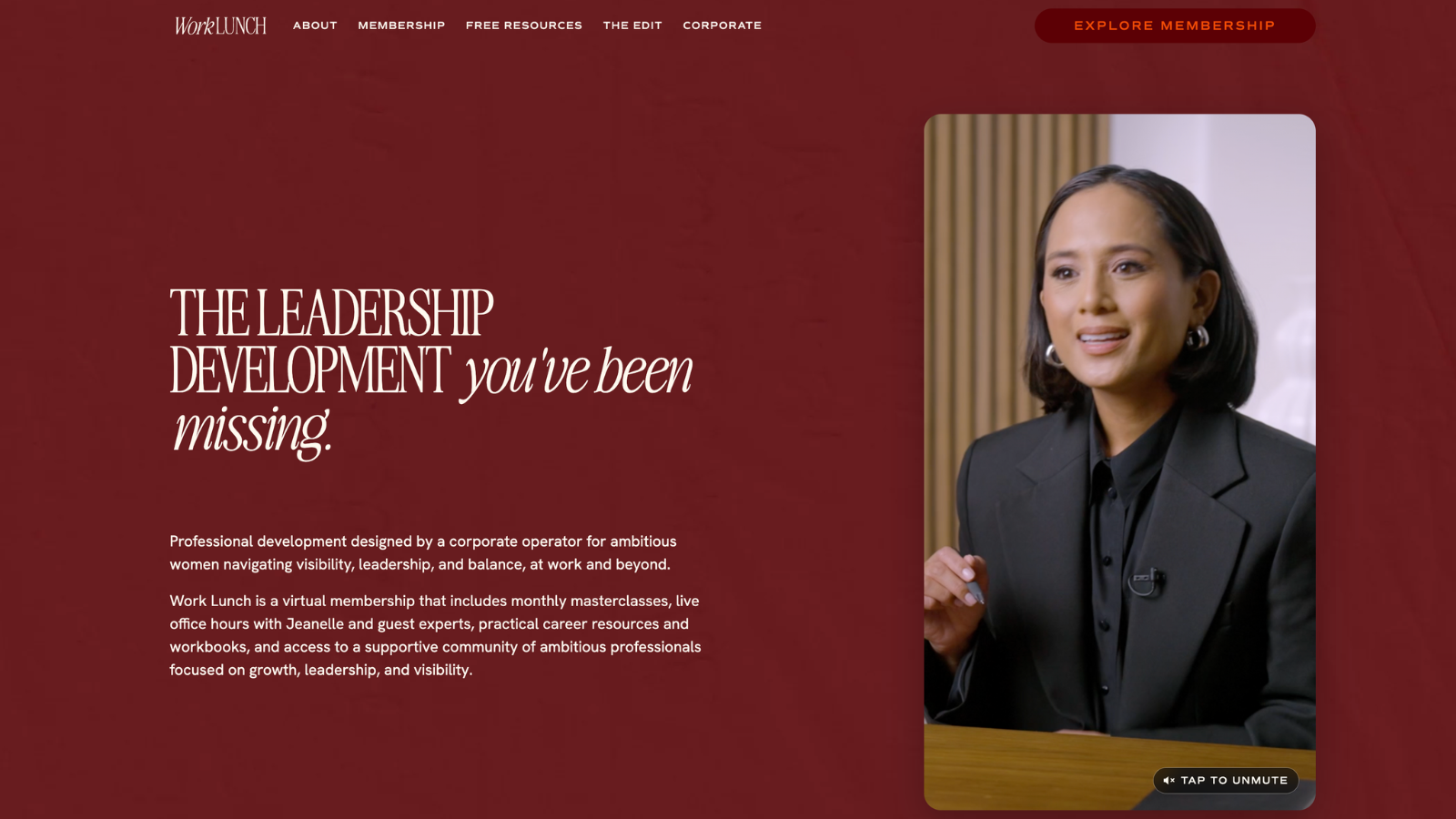
Experts who continue to create a community around their content by being human will build the audiences that feed their businesses.
The Bear Case: Access Is Not Success
Most “State of…” reports take an optimistic view, and this one is no exception.
Hidden within the optimistic future is a real bear case. I stumbled on the real-world example of the bear case in this LinkedIn comment thread:
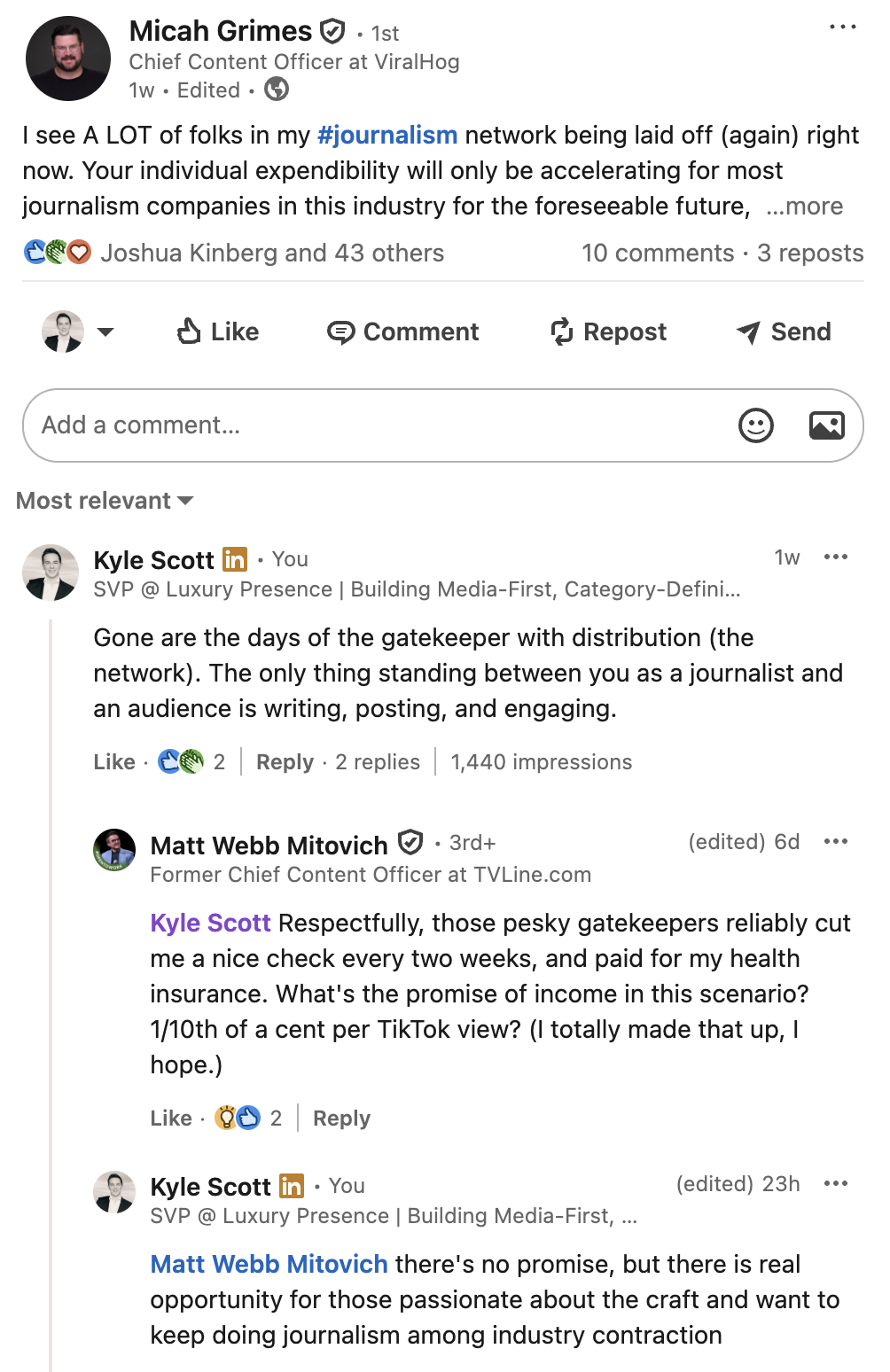
It's easy to say experts can now earn through their own distribution. In fact, I'm saying it here in this report. But opportunity isn't outcome. At birth, anyone could become a pro athlete, yet few actually will, due to interest, capability, or luck.
Democratized access does not lead to democratized success.
Here are the four pessimistic points about the state of the Expert Economy:
The influencer trap. The most seductive way to waste your shot is to build an audience and monetize it like an influencer: Take the brand deal, chase the sponsorship, optimize for eyeballs. That's the Creator Economy's game, and a bad trade for an expert. Ad and sponsorship revenue is rented from platforms and advertisers, and it evaporates when the algorithm changes or the budget dries up.
I spent six years on the operating side of this. We built an education and media brand around one character’s true expertise (Ryan Serhant). His brand deals and speaking engagements were nice cash flow, but they weren’t the real business. Their value was mostly indirect: the stages and brand deals put us in front of a qualified audience and lent credibility, both of which fed the business underneath.
The real business was in the products and services.
Without the underlying business, Ryan was a great channel but not a real company.
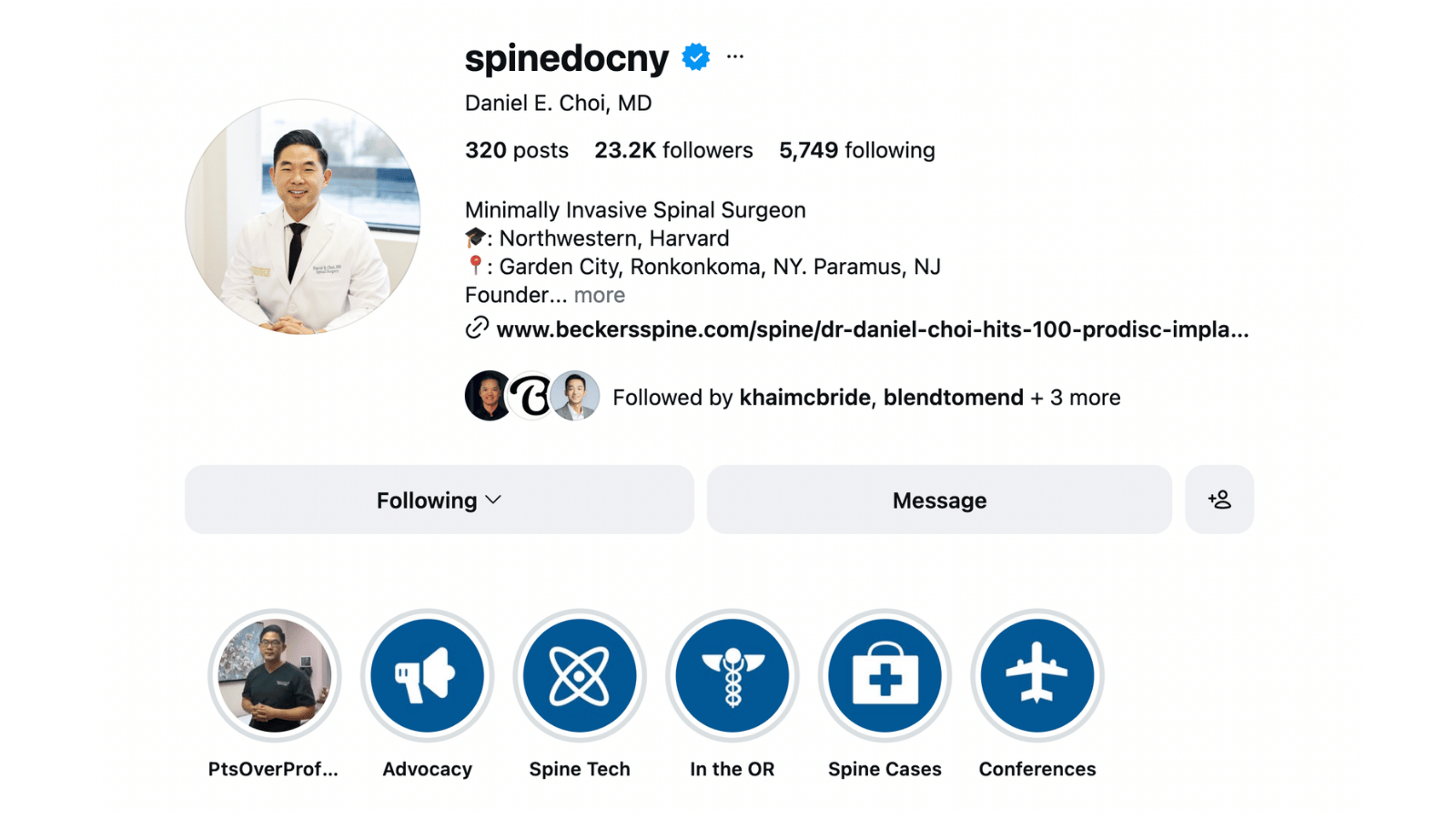
AI eats the undifferentiated. Even inside the Expert Economy, AI commoditizes competent-but-generic expertise: the interchangeable digital marketing freelancer, the “I-do-it-all” lawyer, the anonymous spine surgeon a patient can't tell apart from the next one.
What survives is the expert people seek out by name, like the orthopedic surgeon behind Spine Doc NY. His personality and demonstrated judgment have brought in enough clients to open several locations across Long Island and New Jersey.
Distribution potential is not income. Of the 73 million Americans working independently, only 5.6 million clear six figures (MBO Partners).
Being great at your craft is not the same as building a business around it: Packaging, pricing, and selling expertise is a separate discipline, and it usually takes an operator, not just an expert, to close that gap.
Survivorship bias. Every success story you can point to, mine included, is one you can see because it worked. The people who quit the job, burned through their savings, and quietly went back to a W2 don't publish case studies. Treat every "I did it" story as a framework, not a guarantee. The biggest variable is your willingness to do the work.
None of this is a reason to sit it out. It's a reason to go in clear-eyed about what turns a following into business impact, which is where we go next.
What It Means: The Expert’s Playbook for 2026
Pick a lane and go deep first, then go broad. The durable career shape looks like an oak tree: a strong trunk of genuine expertise in one area, and a wide canopy of adjacent breadth. For most experts, the trunk is their core craft: selling real estate; practicing law; managing wealth; installing plumbing; repairing herniated disks; etc. The canopy is everything else that feeds the trunk: social media content creation, speaking engagements, books, podcast appearances, and more.
Build the audience before you need it. Distribution is free but trust compounds slowly, so the worst time to start building your audience is the moment you need it to bring in clients. The best time to plant a tree was ten years ago. The second best time is today.
Get an operator. This is a gap from the bear case. Yes, AI can help by providing information and ideas. But AI does not (yet) have the nuanced judgement to price, package, market, and sell. If you're the expert, find the operator who can turn your authority into demand for the expertise you already have. If you're the operator, find the expert. Neither wins alone.
Build a room people belong to. An audience you rent on someone else's platform can vanish with an algorithm change, so treat the platform as a tool, not the destination. Move the people who matter into something you own, such as an email list, a membership, or a private community that survives whatever the platforms do next.
Sell something. If your expertise isn't attached to a product or a service, you have a following, not a business. You need a real, valuable product that would still provide value if the platforms disappeared tomorrow.
This playbook holds whether or not you have a W2 job.
If you’re a W2 at a company, your product is just your company’s product instead of your own. You should still be building an audience of qualified buyers to become the go-to person in your lane. The more you’re seen as a recognized expert to your company’s buyer, the more value you provide, and the more valuable you are.
Independent or not, the move is the same in the Expert Economy: Become the name people ask for.
Predictions for 2027
- Half the workforce earns independently. I put this in writing in 2024: Half the country will earn independently by 2027. It's here. More than half of working Americans will earn something on their own, even if most still hold a W2. And, there's no line worth drawing between "experts" and "gig workers": Every gig worker wins the same way everyone else does: by promoting the work. I recently hired a painter off TaskRabbit for his reviews, no different from choosing an expert for the credibility a following or YouTube channel conveys. Once independent work crosses 50%, it stops being a status the minority claims and becomes the default texture of a career.
- "Personal brand" gets a corporate budget. Employee-advocacy and executive-thought-leadership programs become a named, funded function inside large companies, as firms realize their people's reach dwarfs the company's own.
- Verifying who's real becomes a business. As AI-generated content floods every channel, demonstrated track record, peer validation, and "proof of human" become premium signals. Expect a wave of tools and credentials built to prove authenticity.
- The audience comes before the offer. The dominant sequence flips: earn the audience and the trust first, then sell your expertise into it, whether that's advisory, services, memberships, or events, instead of launching a product and hoping an audience forms.
- A wave of consolidation makes the tool matter less. The tools are absorbing each other's features. Circle started as a community tool and now runs courses; the course platforms added communities; the newsletter tools added checkout. As every tool starts doing everything, which one you pick stops being an edge. The operator's advantage moves from features to execution, and to the community, network, and support a platform builds around its software. I've watched this from the platform side: I led the investment in community for our top creators at Thinkific, and I'm leading the same focus on community and network for agents at Luxury Presence. Community and relationship to the brand are differentiators for any software product in an age when feature gaps can be quickly closed by AI engineering.
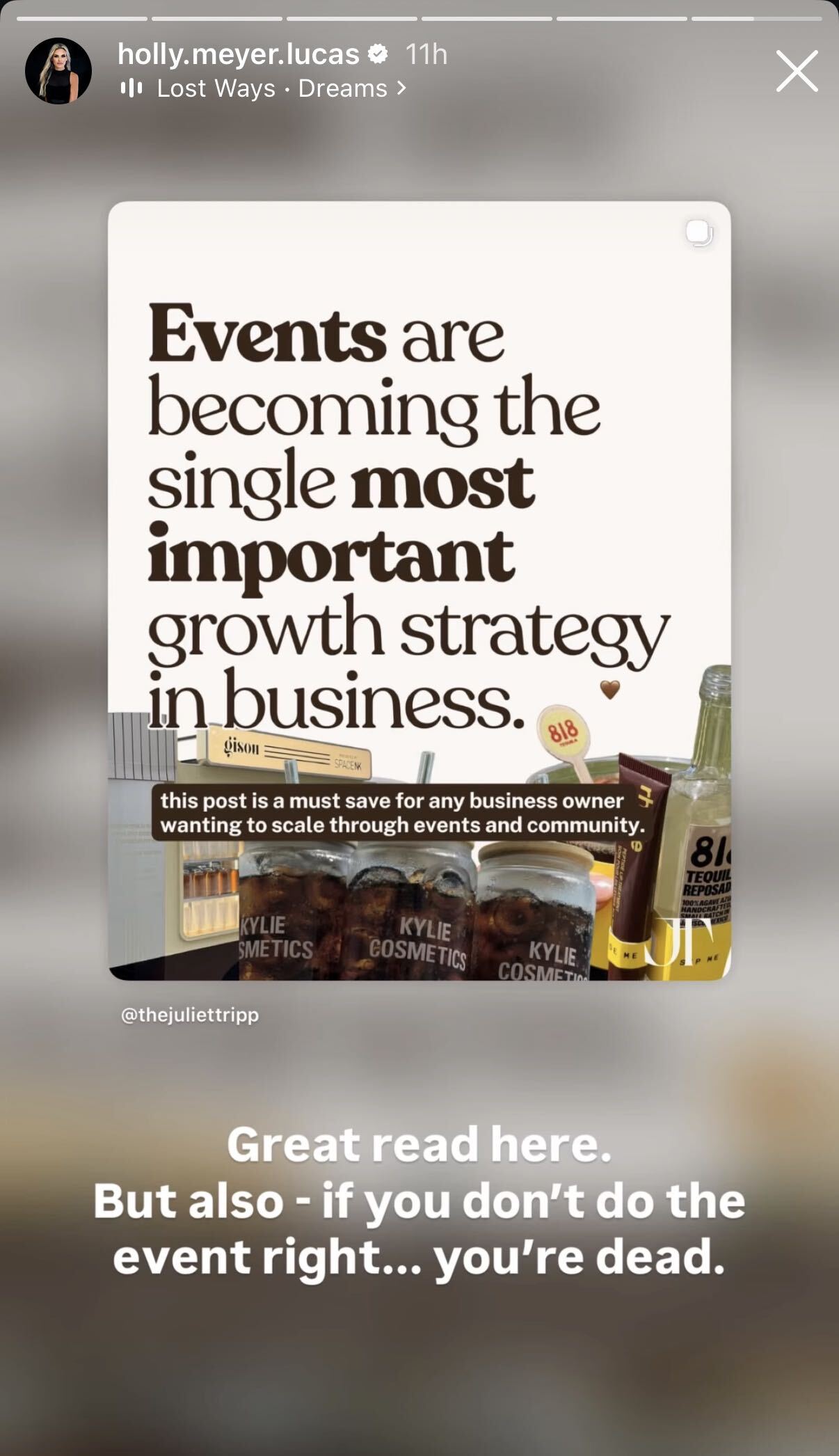
- The human and the in-person make a comeback. People move toward what stays stubbornly human: live events, small rooms, and work obviously made by a person. The scarce thing now is presence. Holly Meyer Lucas, a billion-dollar real estate team leader and the newly named CMO of the trade publication Inman, reshared a post arguing that events have become "the single most important growth strategy in business," then added the operator's caveat: "if you don't do the event right, you're dead." Both halves are true: In-person is a growth opportunity, and the bar for doing it well is rising just as fast.
AI has made the expert more valuable, not less, despite naysayers like Bill Gates, who predicts AI will make doctors and teachers unnecessary. Expertise you can Google is a commodity. The human you trust to apply it is not.
Any AI tool can tell you which funds to buy, how to structure your will, or the symptoms of spinal stenosis. What it can't do is weigh the nuance of your specific situation, or tell you the hard thing you don't want to hear. That distance, between the information and the human, is the opening for every expert. Use the free tools to build an audience, earn its trust, and become the person people come to when the stakes are real.
None of it is guaranteed. Democratized access is not democratized success, and most never close the gap between a following and a business. But the opportunity is real, and it's open right now. The only question is whether you'll take advantage of it today.
If you’re building something in the Expert Economy, I’d love to connect.
Let’s build.
Frequently Asked Questions
What is the "Expert Economy"?
The Expert Economy is the fast-growing segment of the workforce made up of people who build an audience and reputation they own, then use it to generate income for their expertise. Some do this as independents, selling their judgment, services, and advice directly. Others do it inside a company, where a strong reputation raises what their expertise is worth. The audience brings the attention, and the expertise turns it into income.
How is the Expert Economy different from the Creator Economy?
The Creator Economy is an advertising business. About 70% of its revenue comes from brand deals and sponsorships, which makes most of it entertainment and media. The Expert Economy uses the same platforms as distribution to sell expertise directly, whether that is products or services. The Creator Economy monetizes eyeballs, and the customer is advertisers. The Expert Economy monetizes expertise, and the customer is individuals or businesses with a problem.
Hasn't this always existed? Lawyers, consultants, and doctors have advertised for decades.
A billboard says you're good; sharing your demonstrated expertise through thought leadership content shows you’re good and earns trust. Within the Expert Economy, you’re building a reputation as a named character people follow and believe, not a logo they scroll past.
How big is the Expert Economy in 2026?
It is comfortably a multi-trillion-dollar market, though no single statistic captures it, because it cuts across independents, small firms, and employees. For a sense of scale, the U.S. has 30.4 million nonemployer businesses generating $1.8 trillion in receipts (Census Bureau) and 72.9 million independent workers, 27.6 million of them full-time (MBO Partners). Not all of that is expertise; plenty is rideshare, resale, and rentals. But a large and fast-growing share is people selling what they know, and even that counts only those working for themselves with no employees. It excludes anyone running an employer business built on their expertise, and every W2 wage earner generating business by sharing what they know. Include them and the true figure is several times larger.
Is AI a threat to experts?
For generic, output-heavy work, the routine contract a lawyer drafts, the standard financial model an analyst builds, the boilerplate code a developer ships, yes: AI commoditizes competent-but-interchangeable expertise. But it raises the value of judgment, taste, and relationships, and workers with advanced AI skills command a 56% wage premium (PwC). The threat and the opportunity are the same technology, split by whether you compete with AI on output or use it to extend your judgment.
Does the Expert Economy matter if I have a full-time job?
Yes. A W2 job is effectively one company's exclusive subscription to your expertise. The same dynamics (reputation, personal brand, demonstrated authority) shape your options, leverage, and pay, whether or not you ever go independent.
Methodology & Sources
This report draws on primary research and first-party disclosures published through mid-2026: government data (U.S. Census Bureau, U.S. Surgeon General), industry studies (MBO Partners, PwC, Edelman–LinkedIn), investment-bank research (Goldman Sachs), and first-party reporting from Upwork and major news outlets. Workforce figures from different sources use different definitions and are not directly interchangeable. Forward-looking figures are estimates.
Sources:
- Forbes Top Creators 2026 · Forbes
- The Creator Economy could approach half-a-trillion dollars by 2027 · Goldman Sachs
- 2025 State of Independence in America · MBO Partners
- Number of U.S. Nonemployers Grew Faster Than Employer Businesses (2012-2023) · U.S. Census Bureau
- Freelancing Statistics · Upwork
- The Fearless Future: 2025 Global AI Jobs Barometer · PwC
- 2024 B2B Thought Leadership Impact Report · Edelman & LinkedIn
- 2025 B2B Thought Leadership Impact Report · Edelman & LinkedIn
- Solo founders are using AI to do the work of entire teams · Fortune
- Our Epidemic of Loneliness and Isolation · U.S. Surgeon General's Advisory (HHS)
- U.S. e-commerce sales (2025) · Digital Commerce 360
- GDP by Country (nominal, 2025) · Worldometer/IMF
- RIA Edge 100: How Root Financial Found Growth Through Simplicity · WealthManagement.com
- Gen Z is adopting 'career minimalism,' killing off the ladder for a 'lily pad' mentality · Fortune
- Why Career Minimalism Is Spreading Beyond Gen Z · Forbes
- Loneliness in America 2025 · The Cigna Group / Evernorth Research Institute
- Inman Names Holly Meyer Lucas as Chief Marketing Officer · Inman
- Bill Gates: AI will replace doctors and teachers, humans won't be needed for most things · CNBC
Recent Articles
Like It or Not, We’re All in Media Now
If you’re running a company, you have a choice. You can keep posting "look at us" content on social media that gets twelve likes from highly-engaged employees. Or, you can accept that you're in the media business now, and start producing content audiences actually want to consume.


Join Kyle's List
Subescribe to The Kyle File: A quarterly behind-the-scenes dispatch on Kyle's current projects, ideas in development, and life in the arena.